

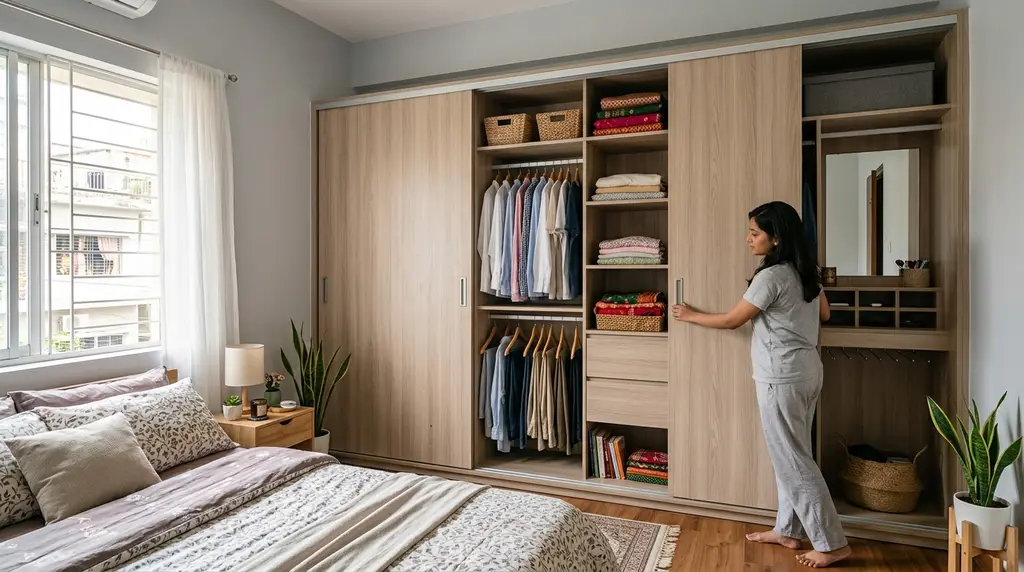
Why wardrobe design matters in a small Bangladesh bedroom
In most Bangladesh homes, the “small bedroom” isn’t just a design challenge—it’s daily life. Between a double bed, a dressing corner, ceiling fan clearance, and limited walking space, the wardrobe can either make the room feel calm and functional or cramped and cluttered. A well-planned wardrobe does more than store clothes: it improves circulation, hides visual mess, and can even make the room look larger with the right door style and interior layout.
When our Interior Design team plans bedroom wardrobes, we start by measuring clearances and movement paths, then match the door type and inside layout to your storage habits. That’s how you avoid common regrets like “the doors hit the bed,” “there’s no space for long dresses,” or “everything is on one shelf.”
Sliding vs hinged wardrobe doors: what works better in Bangladesh?
Both sliding and hinged doors can work beautifully in a small bedroom—if they’re chosen for the right conditions. Here’s how to decide based on space, cost, usability, and the way local rooms are used.
Sliding doors: best when walkway space is tight
Sliding doors are a favorite in compact rooms because they don’t swing outward. If your bed is close to the wardrobe or your room has a narrow passage, sliding doors keep the circulation clear.
- Space-saving: No door swing, so it’s safer and easier to move around the bed.
- Cleaner look: Large flat panels look minimal, which helps small rooms feel less busy.
- Great for mirrors: A full-height mirror panel can replace a separate dressing mirror.
- Trade-off: You can only access one side at a time, and tracks need regular cleaning due to dust.
In Bangladesh, sliding systems perform best when the hardware quality is high. Low-grade rollers can become noisy or misaligned with humidity and frequent use. During our wardrobe design service, we specify track depth, soft-close options, and shutter materials so the doors stay smooth for years.
Hinged doors: best when you want full access and easier maintenance
Hinged doors open outward, giving you full access to the wardrobe at once—especially useful when you’re packing, ironing, or organizing during Eid or wedding season. They’re also simpler to repair compared to sliding tracks.
- Full visibility: You can see and reach everything when doors are open.
- Better for corner solutions: Hinged doors handle L-shaped wardrobes more naturally.
- More accessory options: Door-mounted racks, hooks, and organizers are easier to add.
- Trade-off: Needs door swing clearance, which small rooms sometimes can’t spare.
If your bed edge is less than about 24–30 inches from the wardrobe line, hinged doors often feel annoying. In those cases, we typically recommend sliding doors or a mixed approach (hinged for a narrow side section, sliding for the main panels).
Quick decision guide: sliding vs hinged
- Choose sliding if the wardrobe faces the bed closely, the room has tight circulation, or you want a modern minimal look.
- Choose hinged if you have enough clearance, want maximum access, and prefer simpler long-term maintenance.
- Consider a hybrid if you need both: sliding for the main bay and hinged for a narrow accessory section.
Inside layout guide: how to plan storage that actually works
The inside is where the wardrobe succeeds or fails. A beautiful exterior won’t help if your sarees, shirts, bags, and bedding have no dedicated zones. In our interior design service, we map your wardrobe layout based on lifestyle—office wear, traditional wear, kids’ uniforms, seasonal blankets, and daily accessories.
1) Start with zones: long hanging, short hanging, shelves, and drawers
- Long hanging section: For sarees on hangers, salwar kameez, long dresses, abayas, coats. Plan at least one tall bay so outfits don’t crease.
- Short hanging (double hang): Ideal for shirts, blouses, kids’ clothes. Two rods can double capacity in a small width.
- Shelf stack: For folded T-shirts, jeans, towels, and daily items.
- Drawer block: For innerwear, accessories, makeup, documents, and valuables.
A practical small-bedroom wardrobe often works best with a “60/40” split: one side focused on hanging (especially if you wear office clothing), the other side on shelves and drawers (especially for folded traditional wear and home textiles).
2) Plan a dedicated saree and traditional wear system
Many Bangladesh wardrobes fail because sarees and dupattas are treated like regular folded clothing. Over time they become bulky, wrinkled, and difficult to find. If you have a saree-heavy wardrobe, consider:
- Wide, shallow shelves for neat stacks (easier than deep shelves where piles collapse).
- Pull-out trays for premium sarees and special occasion outfits.
- Soft-lined drawers for jewelry, bindi boxes, and small accessories.
3) Don’t forget bedding and luggage (Bangladesh reality)
Blankets, extra sheets, prayer mats, and suitcases take up more space than we expect. In small bedrooms, the top portion of the wardrobe should do heavy lifting.
- Overhead loft shelf: Great for seasonal blankets and rarely used items.
- Large top cubbies: For luggage and travel bags—keep them off the floor to reduce visual clutter.
4) Add a “daily grab” section near the door edge
Small upgrades make a big difference: a narrow vertical area for everyday items saves time and keeps the room tidy.
- Hooks or a slim hanging rod for office bags, scarves, or a light jacket.
- A small drawer for keys, watch, wallet, and chargers.
- Shoe pull-out (optional): Works well if your bedroom is where you store shoes.
5) Light, ventilation, and materials for humid weather
Bangladesh humidity and dust affect wardrobes. Good design isn’t only about compartments—it’s also about durability and freshness.
- Ventilation gaps: Small airflow provisions help reduce musty odor.
- Quality laminate/finish: Resists swelling and staining better over time.
- Integrated LED lights: Helpful in deep wardrobes, especially with sliding doors.
During our wardrobe installation and detailing work, we also plan edge banding, hardware quality, and moisture-prone wall conditions so the wardrobe stays stable and smooth.
Common layout mistakes in small bedrooms (and how to avoid them)
- Too many shelves, not enough drawers: Shelves look spacious on paper but become messy without drawer organization.
- No full-length hanging: Then long outfits get folded and wrinkled, or you end up using door hooks.
- Deep shelves with no dividers: Clothing piles collapse and items get lost at the back.
- Ignoring door clearance: Hinged doors hitting the bed is one of the most common regrets.
Getting it right: a practical approach for your room
If you want a wardrobe that truly fits your small bedroom, start with a site measurement, decide door type based on clearance, then build an inside layout around how you actually dress and store. Our bedroom interior design process typically includes on-site measurement, layout planning, 3D visualization, material selection, and coordination with carpentry and installation—so the final wardrobe looks clean and works smoothly in daily life.
Sliding or hinged, simple or premium, the best wardrobe is the one that respects the room’s walking space and your routine. Once those two things are aligned, even a small Bangladesh bedroom can feel organized, breathable, and surprisingly spacious.
Explore more on Bedroom, Wardrobe & Kids Spaces
About the author
Sofia turns concepts into detailed plans and polished visuals that help clients decide quickly and confidently. She produces CAD drawings, furniture layouts, lighting plans, and 3D renders tailored to local sourcing options. …
Leave a comment