



I’ve watched gorgeous Dhaka flats fall apart in three months, not because the owners lacked taste, but because the design ignored real life. If you want a home that still feels calm after the first monsoon, the first dust storm, and the first “guests are coming in 20 minutes” panic, start here.
To design a home that truly works in Dhaka, plan around real-life constraints—heat, dust, noise, storage, and maintenance—not just aesthetics. Start by measuring circulation and furniture scale, then set up layered lighting, washable finishes, and cross-ventilation. Finally, zone the home for routines and build “invisible” storage so it stays calm long-term.
Key takeaways
- Design decisions should prioritize airflow, easy cleaning, and noise control—especially in Dhaka apartments.
- Correct furniture scale and circulation widths prevent cramped rooms more than any “style” choice.
- Layered lighting (task + ambient + accent) matters more than expensive fixtures, and it must account for load-shedding.
- Washable, low-dust materials and hidden storage keep a home looking good with less effort.
1) Start with circulation math (not mood boards): the 90–120 cm rule that saves Dhaka apartments
The fastest way to make a Dhaka apartment feel bigger is to stop guessing and start measuring how you’ll move. “Circulation” is just the clear paths your body takes: entry to sofa, kitchen to dining, bed to wardrobe, bathroom to towel.
My rule is simple: if walking feels easy, the room looks expensive. If walking feels tight, no amount of pretty decor will save it.
Quick layout numbers you can copy-paste (living, dining, bedroom)
If you only steal one thing from this article, steal these clearances. I’ve used them in Gulshan rentals with awkward pillars and in older Dhanmondi flats where nothing lines up, and they still hold up.
- Primary walkway: 90–120 cm (main routes you use every day)
- Secondary walkway: 75–90 cm (beside seating, near corners)
- Sofa to coffee table: ~40–50 cm (close enough for tea, far enough for knees)
- Dining chair pull-back space: ~90 cm behind chairs (less if tight, but you’ll feel it)
- Bedside clearance: ~60 cm on at least one side (tight rooms can go less, but plan consciously)
These numbers matter more in Dhaka because many apartments have narrow entries, balcony doors you actually use, and furniture bought “for the next home” that ends up oversized for the current one.
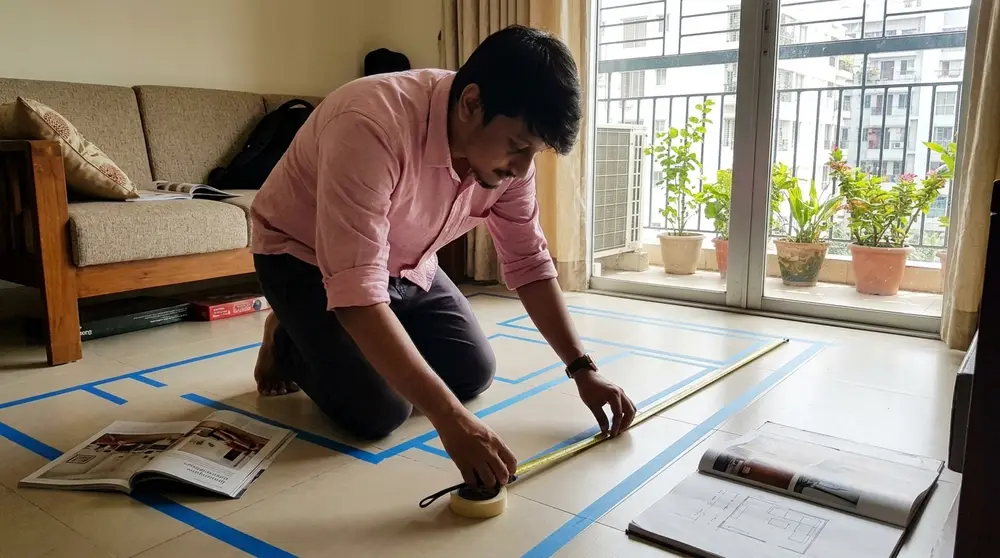
A 15-minute floor-tape test before you buy any furniture
I learned this the hard way after a client ordered a beautiful sectional that arrived like a small boat. We could fit it, sure, but the balcony door became a daily obstacle course, and the TV angle was so weird everyone sat sideways.
Now I do a quick floor-tape test with masking tape before any purchase:
- Measure the room and mark door swings and window openings.
- Tape the footprints of the sofa, coffee table, bed, dining table, and any big storage.
- Walk your real routes while holding something annoying (a laptop bag, a laundry basket, a grocery bag).
- Fix the layout until you don’t bump corners or squeeze past furniture.
This one step prevents blocked doors, cramped paths, and that classic Dhaka mistake: buying a “statement” piece that turns your living room into a narrow corridor.
2) Design for heat and humidity first: where airflow should win over “symmetry”
In Dhaka, comfort is a design feature. Heat and humidity affect how you sleep, how the home smells, how long wood lasts, and how fast fabrics feel sticky.
A quotable rule I use: airflow beats symmetry. Put the chair where the air moves, not where Instagram says it should go.
Cross-ventilation layout: the straight-line airflow check
Cross-ventilation is just air entering from one side and exiting from another. The simple check is to stand at your main window and look for a clear “line” toward another opening: balcony door, opposite window, or even the corridor door if that’s your only outlet.
What blocks airflow most often in Dhaka flats? Tall wardrobes jammed near windows, full-height bookshelves used as partitions, and heavy curtains that stay closed all day to “save the sofa.”
- Keep an air corridor at least shoulder-width from inlet to outlet.
- Use staggered furniture (don’t line up tall pieces like a wall).
- Pick open-base sofas/TV consoles so air can move under them.
- For enclosed rooms, consider louvered doors or a vented transom panel where feasible.
If you want a reference point on why ventilation matters for indoor air quality, the U.S. EPA has a solid overview of how airflow reduces pollutant buildup: https://www.epa.gov/indoor-air-quality-iaq/ventilation-and-air-quality.
Humidity-proof material picks that still look premium
I once specified a budget laminate for a kitchen base cabinet in a humid, low-ventilation apartment. It looked fine for a while, then the edges started to swell and peel right where the mop water and steam hit most.
Now my approach is boring but reliable:
- Marine plywood where there’s real water risk (kitchen sink base, near washing machine).
- Moisture-resistant MDF only in lower-risk zones, and only with properly sealed edges.
- Powder-coated metal for shelves and frames where humidity would punish wood.
- Solid wood is fine if it’s properly seasoned and finished; raw wood in humid corners is asking for trouble.
- Washable paint instead of fancy wall panels in rooms that trap moisture.
In bathrooms and kitchens, I also avoid “too many joints” designs that trap grime and moisture. Fewer seams, fewer regrets.
3) Ask this first: “What will be cleaned weekly?” (Dhaka dust-friendly finishes that don’t look boring)
If it’s hard to wipe, it won’t stay beautiful in a dusty city. That’s not pessimism, that’s just how Dhaka works after a few windy days and open windows.
The trick is to design a home that rewards quick cleaning instead of demanding heroic cleaning.
Low-dust surfaces: what to avoid and what to choose instead
I love texture, but I’ve also watched textured wall panels turn into dust collectors that nobody wants to touch. The same goes for open shelves packed with tiny decor: they look great on day one, then they become a weekly punishment.
- Avoid (in high-dust zones): deep-groove panels, heavy rattan near windows, open shelving everywhere, super glossy surfaces that show fingerprints and smudges.
- Choose instead: matte washable paint, closed storage, wipeable laminates, performance fabrics, and removable cushion covers.
For indoor air and dust basics, the U.S. EPA’s indoor air quality resources are a good starting point: https://www.epa.gov/indoor-air-quality-iaq.
One “show shelf,” the rest closed: a realistic display rule
Here’s the compromise that keeps homes looking styled without becoming a museum you have to dust every weekend: give yourself one main display zone, maybe two. Everything else goes behind doors.
I usually pick a single “show shelf” near the living room where guests naturally look, and I make it easy to wipe. Then I keep the rest boring on purpose: closed cabinets, tall storage, and fewer ledges.
- Group decor in larger pieces (fewer tiny items).
- Use trays so you can lift, wipe, and place back in one move.
- Keep a cleaning cloth in a nearby drawer, not in the farthest bathroom.
This sounds small, but it’s the difference between “my home always looks nice” and “my home looks nice only right after the cleaner leaves.”
4) Use lighting like a system (and plan for load-shedding): a simple layer-by-layer setup
Most Dhaka homes I walk into have the same problem: one harsh ceiling light doing all the work. It flattens faces, makes walls look tired, and turns evenings into a glare fest.
A good setup is a system: ambient to fill the room, task where you do things, and accent to add depth. The fixtures can be simple; the placement is what matters.
The 3-layer lighting formula for every room
My simple formula is “one general light, one working light, one cozy light.” If you do only that, the room instantly feels more lived-in and less like a rental.
- Living: ambient ceiling + side/floor lamp for reading + one accent (picture light, wall washer, or a small spotlight for a plant).
- Kitchen: bright task lighting where you chop (under-cabinet is gold) + safe ambient so there are no shadows.
- Bedroom: warm ambient + bedside task light + wardrobe light so you’re not picking clothes in a cave.
Glare control matters. If a bulb is visible from the sofa, I angle it, shade it, or swap the fixture. Eye-level glare is the sneaky reason a “nice” room feels annoying.
Comparison table to choose bulbs fast: color temperature + best placement
Color temperature is the “warm vs cool” look of light, measured in Kelvin (K). In Dhaka daylight, a slightly warmer indoor light usually feels calmer at night, while neutral light helps in work zones.
If you want a reputable explainer on color temperature and lighting basics, the U.S. Department of Energy has straightforward guidance: https://www.energy.gov/energysaver/led-lighting.
| Color temperature | How it looks | Best placement (Dhaka-friendly) | Quick note |
|---|---|---|---|
| 2700–3000K | Warm, cozy | Bedrooms, living rooms, bedside lamps | Warm light is forgiving on walls and faces, especially at night. |
| 3500–4000K | Neutral, clean | Dining, study corner, general ambient in mixed-use rooms | Good balance if your home has warm wood tones and you don’t want “yellow.” |
| 5000–6500K | Cool, bright | Task/utility: kitchen prep, laundry, store room | Can feel harsh in living spaces; great for seeing true detail while cleaning/cooking. |
For color accuracy, I aim for higher CRI bulbs in living areas so fabrics and skin tones don’t look dull. Many reputable bulb makers list CRI on the box; if it’s not listed, I treat that as a warning sign.
Outage-ready lighting without ruining aesthetics
I keep “night mode” lighting planned from day one, because nothing reveals a bad layout faster than load-shedding. You don’t need ugly emergency lights everywhere; you need a few smart backups where your feet go.
- Use rechargeable bulbs in 1–2 key fixtures (entry and living are my picks).
- Keep a portable lantern in a drawer near the sofa, not buried in a store room.
- Assign one power bank to a small USB lamp for work calls.
- Put a tiny path light or rechargeable motion light in the corridor for safety.
One small detail I swear by: keep switches intuitive. When guests are over and the lights go out, nobody wants to hunt for the one switch that controls the one backup bulb.
5) Make storage invisible: design “pressure relief zones” for bags, shoes, and daily clutter
Storage is not cabinetry. Storage is behavior design. If the home doesn’t have an obvious place for shoes, bags, keys, bottles, and “stuff that arrives,” clutter will win every time.
I build “pressure relief zones” where clutter naturally lands, so the rest of the home stays visually quiet.
Entryway micro-zone: the 60 cm-wide solution that changes the whole home
Most Dhaka apartments don’t have a real foyer, so you have to fake one. Even a 60 cm-wide strip can work if it’s planned like a kit: shoes, keys, umbrella, and a quick sit-down spot.
- Slim shoe cabinet (ventilated if possible, because trapped shoe smell is real).
- Hooks at two heights (adult + kid/bag height).
- Tray for keys and small items (so they don’t migrate to the dining table).
- Concealed umbrella slot (monsoon days make this non-negotiable).
- Easy-clean mat you can shake and wash.
The first time I designed an entry without a place to sit, the homeowner started using the sofa arm to balance while wearing shoes. It looked messy fast. A small perch fixes that habit overnight.
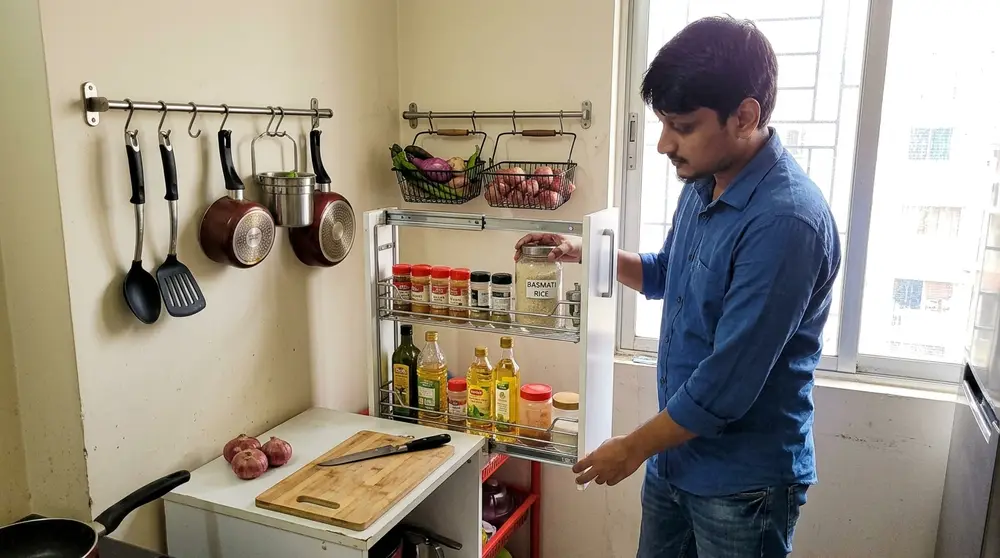
Kitchen verticalization: store up, not out (with a buy-list)
Dhaka kitchens often have limited counter space, and the heat makes you want to wipe things down fast. The goal is simple: keep counters clear so cooking and cleaning are both easy.
Here’s the buy-list I use again and again (and yes, it works even in rentals):
- Wall rail with hooks (spatula, ladle, small strainer)
- Magnetic strip for knives (only if you have safe placement)
- Pull-out pantry unit or a tall narrow rack
- Stackable containers for dry goods
- Under-sink caddy for cleaners (so bottles stop rolling around)
- Corner carousel/lazy susan for deep cabinets
- Labeled jars and drawer dividers for spices and sachets
My personal rule: if you can’t wipe the counter in one minute, the storage system is wrong. Fix that, and the kitchen starts feeling like a calm workspace instead of a crowded shelf.
6) Treat noise like a design material: small changes that make Dhaka homes feel expensive
Noise is one of those “rarely spoken about” design problems because it’s not photogenic. But the difference between a stressful home and a calm home is often sound, not decor.
A practical rule: seal air gaps first, then add soft layers. People do it backward and wonder why the curtains didn’t solve traffic noise.
Seal first, then soften: the correct order for sound control
I’ve been in apartments where you could hear corridor conversations like they were inside the living room. In those cases, rugs won’t save you until you stop sound leaks around doors and windows.
- Add a door sweep or draft stopper at the bottom of the main door.
- Check window gaps and add simple weatherstripping where possible.
- Use thick curtains with sheers (sheers for daytime privacy, thick layer for evenings).
- Put felt pads under chairs and tables so scraping doesn’t echo.
- Place a bookcase (even half-filled) on a shared wall to reduce perceived echo.
To keep expectations realistic: without construction, you’re reducing perceived noise and echo, not fully soundproofing. For background on why long-term noise affects health, the World Health Organization’s environmental noise guidance is a reputable reference: https://www.who.int/publications/i/item/9789289053563.
Acoustic styling that still looks modern
Sound control doesn’t mean turning your living room into a recording studio. A few soft, large surfaces do most of the work, and they can look clean and modern if you keep them intentional.
- Upholstered headboard behind the bed (quiet comfort you feel immediately).
- Large rug that actually fits the seating area (tiny rugs are basically coasters).
- Fabric wall art or a textile panel instead of a wall full of hard frames.
- Layered curtains with a proper rod, hung high enough to look tailored.
One warning from experience: clutter is not “acoustic treatment.” A pile of random objects makes cleaning harder and stress higher, and it barely helps the sound.

7) Design around routines: zoning for prayer, work calls, kids’ study, and guests
The most functional homes I’ve designed weren’t the fanciest. They were the ones where the owners could live their day without constantly moving things around.
A quotable approach: routines decide the layout. Once you map what you actually do, the right zones almost design themselves.
The 10-minute routine map (a mini exercise)
I do this with clients before we talk about colors. We sit with a note on the phone and list the daily stuff that causes friction. The answers are always practical: “Where do I take work calls?” “Where do the kids spread books?” “Where do guests sit when the dining table is messy?”
- Write your morning routine, evening routine, and weekend routine.
- Add Dhaka-specific realities: laundry drying, prayer/meditation, grocery unloading, quick guest hosting.
- Turn each routine into needs: privacy, charging, task light, storage, quiet.
That list becomes your design brief. It’s hard to overspend on the wrong things when your home is planned around real use.
Flexible zoning tricks when you don’t have an extra room
Small apartments can still have zones, they just can’t have permanent walls everywhere. I like “soft boundaries” that change with the day: light, rugs, curtains, and furniture orientation.
- Use a curtain or fabric panel as a temporary divider for calls or study.
- Define a “work island” with a rug and a focused task lamp.
- Choose a foldable desk or wall-mounted drop-leaf so it disappears after hours.
- Use nesting tables for guests instead of one giant coffee table.
- Let lighting signal the zone: warm corner light for relaxing, brighter task light for work.
Two quick don’ts I’ve learned by fixing messy layouts: don’t block airflow with partitions, and don’t create so many mini-zones that the room becomes a maze.
8) Stop copying Pinterest proportions: scale your palette, patterns, and art to your room size
The most common “Pinterest mistake” I see in Dhaka is proportion. Small rooms get sprinkled with tiny decor and busy prints, while big walls get one undersized frame floating sadly in the middle.
A clear rule: scale is what makes a room feel finished. It’s not about expensive items. It’s about choosing fewer things that fit the space properly.
Proportion rules that prevent “unfinished” rooms
If you want the room to look intentional in photos and in real life, these are the rules I keep coming back to. They’re simple, but they stop most visual awkwardness.
- Rugs: big enough that the front legs of key furniture sit on it (so the seating feels “anchored,” not scattered).
- Curtains: hang them higher and wider than the window so the window looks larger and the ceiling feels taller.
- Wall art: aim for roughly 2/3 to 3/4 the width of the sofa/console below it.
- Patterns: pick one hero pattern per room, then keep the rest quieter.
One of my favorite fixes is replacing four tiny frames with one larger piece. The wall instantly feels calmer, and cleaning becomes easier too.
A Dhaka-friendly palette strategy (heat, light, and dust in mind)
Dhaka daylight is strong, and dust is honest. Ultra-dark glossy finishes show every mark, while ultra-white can look harsh and tiring under mixed lighting.
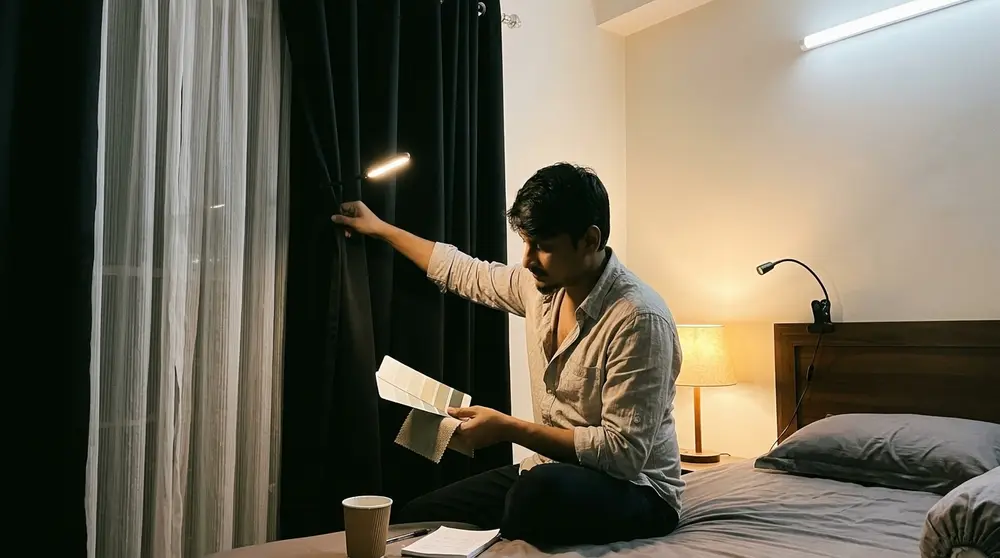
My practical palette approach is mid-tone neutrals as the base (they hide dust better than pure white), with deeper accents where durability matters most: sofa upholstery, a rug, or dining chairs. And I always test paint on the wall at different times of day, because the same color looks completely different at noon versus a rainy evening.
- Test 2–3 sample patches and check them in morning, afternoon, and night lighting.
- Match undertones to your daylight: warm neutrals feel softer; cooler neutrals can look crisp but may feel cold at night.
- If your home gets dusty fast, avoid finishes that require constant buffing to look clean.
Here’s the last thing I tell clients before they start buying: a home doesn’t need more stuff. It needs fewer mistakes that you have to live around. Build it for your real week, and it will keep paying you back every day.
Leave a comment